
45-Minute Home Workout Plan: A Simple Full-Body Session
Train your whole body at home in 45 minutes with a warm-up, a repeatable strength circuit, a low-impact finisher, and easy ways to make each move harder or easier.
In this article
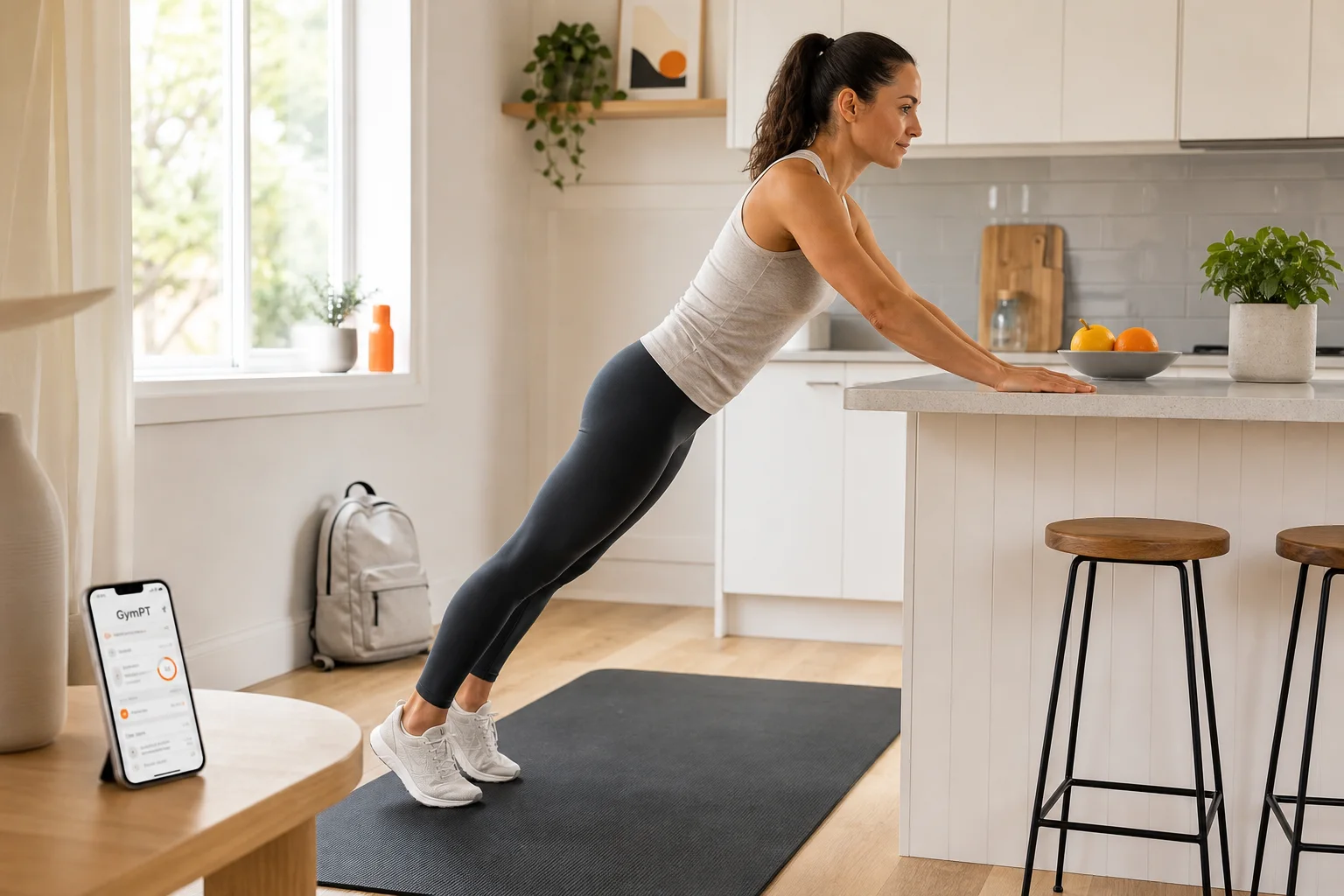
A 45 minute home workout plan can cover your whole body without a gym or a large training area. The key is to choose a few useful movement patterns, set up the space before you start, and use a steady pace that lets you keep control. This session uses bodyweight exercises and an optional backpack loaded with books or water bottles. You’ll need roughly a mat-sized space, a stable chair or countertop for supported push-ups, and a timer.
The plan below has a six-minute warm-up, a 27-minute strength circuit, a seven-minute low-impact finisher, and a five-minute cool-down. Adjust the exercises and rest to match your current ability. If you’re new to regular training, try three circuit rounds first and use the remaining time for extra recovery or gentle movement.
How to set up your 45-minute home workout plan
Clear anything you could trip over, check that your chair or other support is stable, and leave enough room to step back and lie down. Keep water nearby. You don’t need to rush between exercises: the time blocks provide a guide, not a reason to sacrifice good movement.
This is a full-body strength session, not a complete weekly activity plan by itself. U.S. physical activity guidance recommends muscle-strengthening activity on at least two days a week for adults, alongside aerobic activity. You can use this workout on one of those days and repeat it on a separate day if it fits your schedule and recovery.
Six-minute warm-up
Move continuously at an easy pace for six minutes. The goal is to get comfortable with the movements you’ll use, not to tire yourself out.
- March in place: 60 seconds, starting gently.
- Arm circles and reaches: 60 seconds, changing direction halfway through.
- Hip hinges: 60 seconds; push your hips back while keeping your torso steady.
- Comfortable bodyweight squats: 60 seconds, using a chair behind you as a depth target if helpful.
- Wall or countertop push-ups: 60 seconds at an easy angle.
- Alternating reverse steps: 60 seconds, keeping the steps small and controlled.
Twenty-seven-minute full-body strength circuit
Complete the five exercises below in order. Work for up to 45 seconds, then take 15 seconds to change position. After all five moves, rest for one minute. That makes one six-minute round. Complete four rounds, including one minute of rest between rounds one, two, and three: 24 minutes of timed exercise plus three minutes of between-round rest.
Choose a version you can perform smoothly. If 45 seconds is too long, stop when your technique starts to slip, rest, and resume only if you feel ready. You do not have to reach exhaustion for the session to count.
- Chair-target squat: Stand in front of a stable chair, feet about hip- to shoulder-width apart. Bend your hips and knees to a comfortable depth, then stand. Lightly touch the chair if that helps you control the movement; don’t drop onto it.
- Incline push-up: Place your hands on a wall, sturdy countertop, or other fixed support. Keep your body in a comfortable straight line as you bend your elbows and bring your chest toward the support. Use a higher surface to make the move easier.
- Backpack row: Put a few books or bottles in a backpack and check that it is closed and secure. Hinge forward slightly, hold the pack with both hands, and draw it toward your lower ribs. Lower it slowly. Start with a light load, or use an unweighted arm-pull motion if you’re unsure about the setup.
- Glute bridge: Lie on your back with knees bent and feet on the floor. Press through your feet to raise your hips comfortably, pause briefly, and lower with control. Keep the movement smooth rather than arching your back to lift higher.
- Dead bug: Lie on your back with knees bent and feet lifted if comfortable. Brace gently, then slowly reach one heel toward the floor while moving the opposite arm overhead. Return and switch sides. Keep the range small enough to maintain a steady torso. For an easier option, keep both feet on the floor and alternate heel taps.
If you prefer to follow a simpler starting structure, see our beginner strength training plan. For more bodyweight exercise ideas matched to your available setup, explore our calisthenics workout plan.
Seven-minute low-impact finisher
This short block adds movement without jumps or noisy equipment. Alternate the following two options for six minutes: 40 seconds of comfortable effort, followed by 20 seconds of easy marching. Repeat the pair three times, then spend the final minute walking slowly around your space and letting your breathing settle.
- March and reach: March in place while reaching one arm overhead at a time. Keep the pace controlled.
- Side steps: Step gently from side to side, adding relaxed arm swings if comfortable.
Choose a pace at which you can keep moving smoothly. If you feel unusually breathless, dizzy, or unwell, stop and take a break. This finisher is optional; you can use the seven minutes to rest or cool down more gradually instead.
Five-minute cool-down
Walk slowly or march gently for two minutes. Spend the remaining three minutes on relaxed, comfortable stretches for the areas you trained, such as the front of the hips, chest, or back of the legs. Hold each position without bouncing, and ease off if it feels painful. There’s no need to force a particular stretch or range.
Make the workout easier or harder
Progression means gradually changing the challenge while keeping the exercise controlled. You don’t need to change everything at once. Pick one adjustment, use it consistently, and note how it feels.
- For an easier session: Use a higher surface for push-ups, keep squats shallow, use a lighter backpack, shorten work intervals, or complete three rounds instead of four.
- For a harder session: Add a small amount of weight to the backpack, use a slightly lower push-up surface, increase a movement’s range if comfortable, or add a few controlled repetitions within the work interval.
- For a repeatable challenge: Keep the same exercise versions for several sessions and record your rounds, repetitions, or backpack load. When the work feels manageable and your form stays consistent, make one small change.
That gradual approach is more useful than turning every session into a race. For a deeper guide to making training harder methodically, read our progressive overload workout plan.
How to fit this home workout into your week
Start with one session if you’re building the habit, then consider a second session on a different day when you’re ready. Leave enough time between demanding sessions to feel prepared to train again. On other days, walking or another activity you enjoy can complement strength training. The right schedule is the one you can repeat without making every workout feel like a test.
Use a basic workout log to save exercise versions, rounds, and notes such as “use a lighter backpack next time” or “countertop push-ups felt controlled.” GymPT lets members record training and build a manual program without AI credits. You can also request optional AI assistance or review a personal trainer’s program proposal and decide whether to save and use it. A trainer can review only the programs, workout records, and notes you permit them to share. For more on keeping a useful record, see our exercise tracking app guide.
Keep the session practical: clear your space, choose repeatable exercise variations, and progress a little at a time. A well-paced home workout does not need elaborate equipment to give you a structured way to train.