Calisthenics Workout Plan: Match Each Move to Your Equipment
A calisthenics plan is easier to follow when every exercise fits the equipment you can reliably use. Use this two-day template and adapt it to your space.
In this article
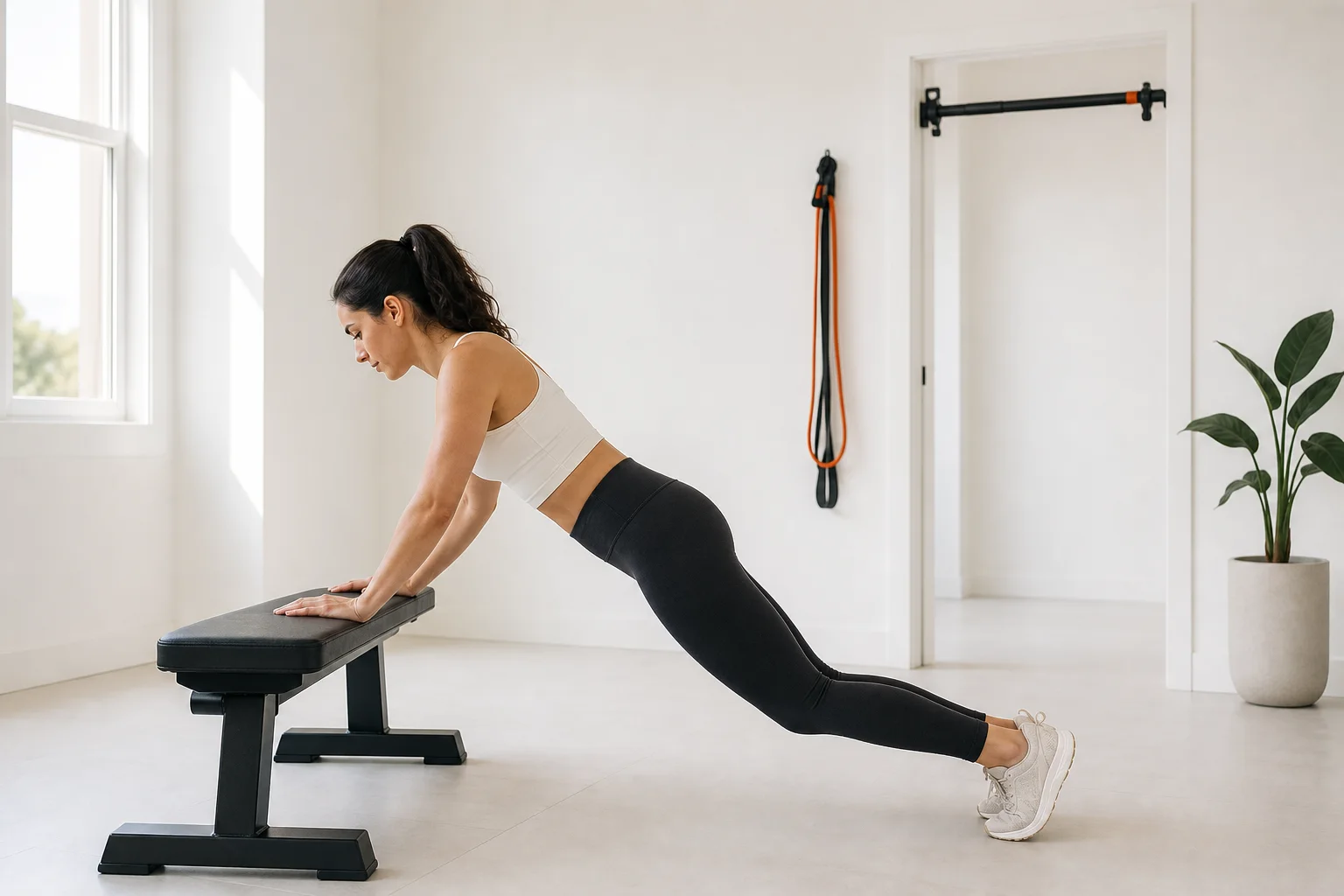
A useful calisthenics workout plan starts with the equipment you can actually use—not a list of impressive moves that depend on gear you do not have. A clear space and the floor can cover several movements. A securely installed pull-up bar or resistance band can add a way to train pulling muscles. If you train in a gym, a stable bench or low bar can open up more options.
The goal is to choose a manageable routine that trains your major muscle groups, fits your space, and can be repeated consistently. This two-day full-body template offers options for different equipment setups, plus straightforward ways to adjust the difficulty.
Choose your equipment before choosing exercises
Do a quick check of your training space and list what is reliably available. Think in terms of movement options rather than collecting equipment: Can you push? Squat or step? Train your hips? Pull against resistance? Keep your balance? Your answers help determine which exercise variations belong in the plan.
- Floor and clear space: suitable for floor push-ups, split squats, glute bridges and trunk exercises.
- Stable chair or step: may support a seated-to-standing squat variation or low step-ups if it cannot slide, tip or wobble.
- Resistance band: can provide pulling resistance when used with an appropriate, secure anchor and according to its instructions.
- Pull-up bar or gym station: offers a practical way to work on vertical pulling. Check that equipment is installed and rated for use before training.
- Low, stable bar or suitable suspension setup: can make rows possible. Use only equipment designed for this purpose.
Do not improvise an anchor with a loose door, lightweight table, rolling chair or furniture that could shift. If you cannot establish a safe pulling setup, use a gym station or get advice on a suitable alternative instead of forcing a risky version.
Calisthenics workout plan: a simple two-day template
Schedule the sessions on nonconsecutive days, such as Monday and Thursday. Start with one or two sets per exercise if you are new to training, then add a set when the routine feels manageable. For many movements, a set of roughly 6–12 controlled repetitions is a practical starting point; for holds, use a duration you can maintain without losing position. Stop with a little room to spare rather than turning every set into a test.
Rest long enough to perform your next set with control—often around one to two minutes, or longer if needed. The sample ranges are starting points, not requirements. Choose a version that lets you move steadily and safely.
Workout A
- Push: incline push-up against a stable, non-sliding surface, or a floor push-up — 2–3 sets of 6–12 repetitions.
- Knee-dominant legs: squat to a stable chair or comfortable free squat — 2–3 sets of 8–12 repetitions.
- Hip extension: glute bridge — 2–3 sets of 8–15 repetitions.
- Pull: band row with a secure anchor, or a row on appropriate, stable equipment — 2–3 sets of 8–12 repetitions.
- Trunk: dead bug or a comfortable plank variation — 2–3 controlled sets.
Workout B
- Push: incline push-up or floor push-up — 2–3 sets of 6–12 repetitions.
- Single-leg legs: supported split squat, holding a stable support for balance if needed — 2–3 sets of 6–10 repetitions per side.
- Hamstrings and hips: glute bridge with a controlled pause, or a single-leg bridge if the two-leg version is easy — 2–3 sets of 8–12 repetitions.
- Pull: assisted pull-up on suitable equipment, or band row with a secure anchor — 2–3 sets of 6–12 repetitions.
- Trunk: bird dog or side plank from the knees — 2–3 controlled sets per side.
These sessions cover basic pushing, leg work, hip extension, trunk control and pulling when suitable equipment is available. Bodyweight training can build strength, but the right exercise depends on how challenging it is for you and whether you can progress it over time. General activity guidance for adults also recommends muscle-strengthening activity on at least two days a week, with exercises that work the major muscle groups.
How to adapt the plan to what you have
If you have no equipment
Use floor push-ups, squats, split squats, glute bridges and trunk exercises. For upper-body pulling, be realistic about the limitation: floor exercises do not replace a progressive row or pull-up. You might train at a gym for that movement, or add purpose-designed equipment that can be safely anchored. Avoid using household objects that are not intended to bear your body weight.
If you have a band
Add a band row, checking the anchor, band condition and setup before each session. If the band is too difficult, use a lighter band or stand closer to the anchor when that is permitted by the equipment instructions. If it is too easy, select a stronger band or adjust your position gradually while keeping the anchor secure and your movement controlled.
If you have a pull-up bar
Use an assisted variation that you can control, such as foot-assisted repetitions when the setup allows it. If you cannot yet perform a smooth pull-up, do not make every set a maximum-effort attempt. Use a suitable band or another safe pulling station, and progress gradually.
If you train in a gym
Use the equipment available at that branch: a stable row station, assisted pull-up machine or appropriate low bar can fill the pulling gap. A bench or step may also add safe exercise choices. Confirm what is available before planning the session, especially if your routine depends on a particular station. For more on planning around changing equipment access, see Gym Equipment Availability and Member Training.
Progress without changing everything at once
Keep the movement variation, sets and repetitions in your training record. When you can complete the top of the chosen repetition range for every set with steady control on more than one session, make one small change: add a repetition, add a set within your plan, or choose a slightly harder variation. Then build again. You do not need to make an exercise harder every week.
- Push-ups: begin with hands on a high, stable surface; lower the hand position as the variation becomes manageable.
- Squats: start with a comfortable range or a chair target; gradually increase range or use a harder single-leg variation if appropriate.
- Glute bridges: begin with two legs; try a pause at the top before considering a single-leg version.
- Rows: adjust band resistance or body position only when the anchor and equipment are secure.
- Trunk work: use shorter, well-controlled holds or smaller movement ranges before increasing duration or complexity.
Change one variable at a time so you can tell what is working. If technique becomes inconsistent, the range is uncomfortable, or you cannot control the lowering phase, return to an easier version. A simple plan you can repeat is more useful than frequently swapping in advanced exercises.
Make the routine fit your real week
Two full-body sessions are a practical starting structure, not a rule that everyone must follow. If you are new to training, begin with a manageable number of sets and build gradually. If you already follow a sports or strength program, fit these sessions around your other training instead of simply adding more work.
Use a brief warm-up to rehearse the movements at an easy effort, and keep the equipment setup consistent. Record the exercise variation, sets, repetitions and any equipment change that affected the session. That makes it easier to repeat a workout at home or adjust when you reach a different gym.
In GymPT, members can build a program manually without AI credits and save training records with a free account. If a personal trainer shares a program proposal, you decide whether to review, save and use it. A trainer can review only the programs, workout records and notes you permit them to see. For a beginner-friendly way to structure two weekly sessions, explore the Beginner Strength Training Plan and 2 Day Workout Plan for Strength. If your available gear includes dumbbells, the Dumbbell Only Workout Plan covers another equipment-based option.
Keep the plan simple enough to follow
Your equipment list should shape your exercise choices, not stop you from training. Start with two repeatable sessions, choose versions that fit your current ability, and make sure each setup is stable before you begin. Track what you did, progress one step at a time, and adjust the plan when your schedule or equipment access changes.