Dumbbell Only Workout Plan: Choose the Right Moves for Your Weights
A useful dumbbell-only plan depends on more than exercise names. Learn how to match movements to your weights, train your whole body and progress when your equipment is limited.
In this article
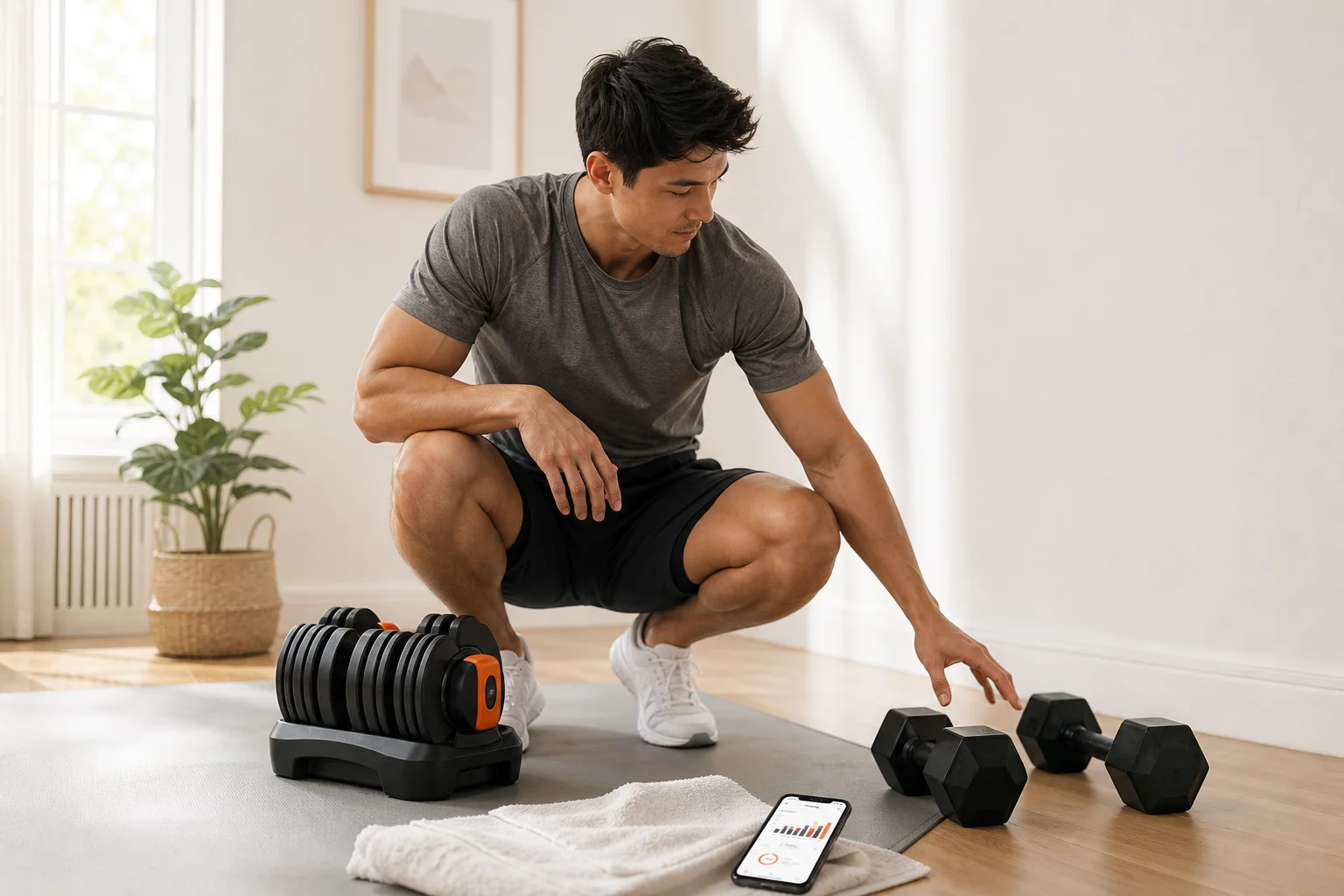
A dumbbell only workout plan should fit the weights you actually own—not an imaginary gym setup. A single light dumbbell, a pair of fixed weights and adjustable dumbbells create different programming choices. The aim is to cover the main movement patterns with exercises you can control, then adjust the challenge as you get stronger.
You do not need a bench or a long list of exercises to begin. With a clear selection process, a pair of dumbbells and some open floor space can support a balanced strength routine. Here is how to choose movements around your equipment, build a practical starting plan and make sensible progress without adding machines.
Start with the equipment you have
Before choosing exercises, take stock of your setup. Note whether you have one dumbbell or a pair, the available weights, whether the weights are adjustable and how much space you can use. Also consider whether getting into position or lifting a weight overhead feels manageable for you. These details help you choose movements that are challenging without making setup awkward.
- One dumbbell: Favor movements that work one side at a time, such as a supported row, split squat or one-arm floor press. Switch sides and keep the work balanced.
- A pair of dumbbells: Use both weights when they are manageable, or hold one weight for movements such as a goblet squat. Single-arm and single-leg options are still useful.
- Fixed, light weights: Select exercises where the available load is challenging for your current ability. You can also increase repetitions or use a controlled range of motion.
- Adjustable weights or several pairs: Match the load to each movement. Your pressing weight may differ from the weight you can use for a squat or hinge.
Do not assume that every exercise should use the same weight. A dumbbell that feels suitable for a row may be too heavy for a shoulder press, while a weight that challenges your legs might feel too easy for a floor press.
Choose exercises by movement pattern
Instead of collecting a long list of exercises, choose one reliable option for each major pattern. This makes gaps in your routine easier to spot and substitutions easier when an exercise does not suit your available weights.
- Squat: Goblet squat, with one dumbbell held close to your chest.
- Hinge: Dumbbell Romanian deadlift, lowering the weights along your legs while keeping your trunk controlled.
- Single-leg work: Reverse lunge or split squat, using bodyweight first if holding a weight makes balance difficult.
- Push: Dumbbell floor press for a horizontal press, or a standing press if the weight is manageable overhead.
- Pull: One-arm dumbbell row, using your free hand on your thigh for support if needed.
- Carry or trunk stability: Suitcase hold or march in place while holding one dumbbell at your side, provided you can maintain a steady posture.
A floor press can stand in for a bench press when you have no bench. A row can be done without a bench as well; brace your free hand on your thigh and keep your back steady. For movement examples and alternatives, the equipment-based exercise selection guide explains how to match programming to what is available.
A simple dumbbell-only workout plan to start with
Use this as a flexible template, not a test. Start with a load that lets you move smoothly and stop a set while you can still maintain control. For many people, two or three sets of roughly 8–12 repetitions is a reasonable starting point; choose fewer repetitions if the movement is difficult to control, or more if the weights are light. Rest long enough to be ready for the next set.
Workout A
- Goblet squat: 2–3 sets of 8–12 repetitions.
- Dumbbell floor press: 2–3 sets of 8–12 repetitions.
- Dumbbell Romanian deadlift: 2–3 sets of 8–12 repetitions.
- One-arm dumbbell row: 2–3 sets of 8–12 repetitions per side.
Workout B
- Reverse lunge or split squat: 2–3 sets of 6–10 repetitions per side.
- Standing dumbbell press: 2–3 sets of 8–12 repetitions, using a lighter load if needed.
- Glute bridge with a dumbbell across the hips: 2–3 sets of 8–15 repetitions.
- One-arm dumbbell row: 2–3 sets of 8–12 repetitions per side.
Alternate A and B across two or three weekly strength sessions, leaving time to recover between sessions. For example, two sessions could be A then B; with three, use A, B, A one week and B, A, B the next. If you are new to strength training, start at the lower end of the sets and build gradually. The beginner strength training guide offers a simple way to organize early sessions.
These templates include a squat or single-leg movement, a hinge, a push and a pull. That balance matters more than adding several versions of the same curl or press. General U.S. activity guidance recommends muscle-strengthening activity on at least two days each week; choose a schedule you can maintain and adjust to your circumstances.
How to progress when your dumbbells are limited
Progress does not have to mean buying heavier weights immediately. First, record the exercise, load, sets and repetitions you complete. When you can perform the top end of your chosen repetition range with consistent control, consider one small change:
- Add a repetition to each set, then work toward the top of your range.
- Increase the dumbbell load if you have a suitable next weight and can still perform the movement well.
- Add a set if you are recovering well and have time for the extra work.
- Use a single-side variation when appropriate, such as a split squat instead of a two-leg squat.
- Make the lowering phase deliberate and repeatable rather than rushing through the movement.
Change one variable at a time so you can tell what is making a session more demanding. You do not need to force every set to the point where another repetition is impossible. The 2026 American College of Sports Medicine guidance emphasizes consistency and tailoring resistance training to the person and goal; complicated methods are not a requirement for a useful routine.
Adapt the plan to your real-life setup
If your lightest weights are too heavy for a press, use a lighter available dumbbell, reduce the range only if you can still move comfortably, or choose a push-up variation as an optional bodyweight alternative. If your heaviest weights feel too light for lower-body work, try a single-leg version you can perform steadily rather than rushing through high repetitions. If balance is the limiting factor, keep a hand near a wall for support or choose a stable two-leg movement.
Keep a note of the weights available at home, how much time you have and any exercises you want to swap. GymPT lets you build and save a manual program without AI credits, so you can record a straightforward routine around your equipment. You can also request optional AI assistance, or review and save a proposal from a personal trainer. A trainer only reviews the programs, workout records and notes you permit them to see; a proposal is yours to accept or leave unsaved.
For a broader look at fitting a routine to the week, see the two-day strength plan. If your available equipment changes by location, the guide to equipment availability and member training can help you plan around what you can access.
Keep the plan simple enough to repeat
A well-chosen dumbbell routine covers the main movement patterns, uses weights you can handle with control and gives you a clear way to track progress. Start with a manageable number of exercises, keep notes and adjust one detail at a time. The best plan is not the one with the most variations; it is one you can follow consistently and adapt when your equipment, schedule or training level changes.