
40 Minute Muscle Building Workout Plan: Two Efficient Full-Body Sessions
A practical two-session plan for building muscle when time is limited. Learn what to do in each 40-minute workout, how to progress, and how to recover between sessions.
In this article
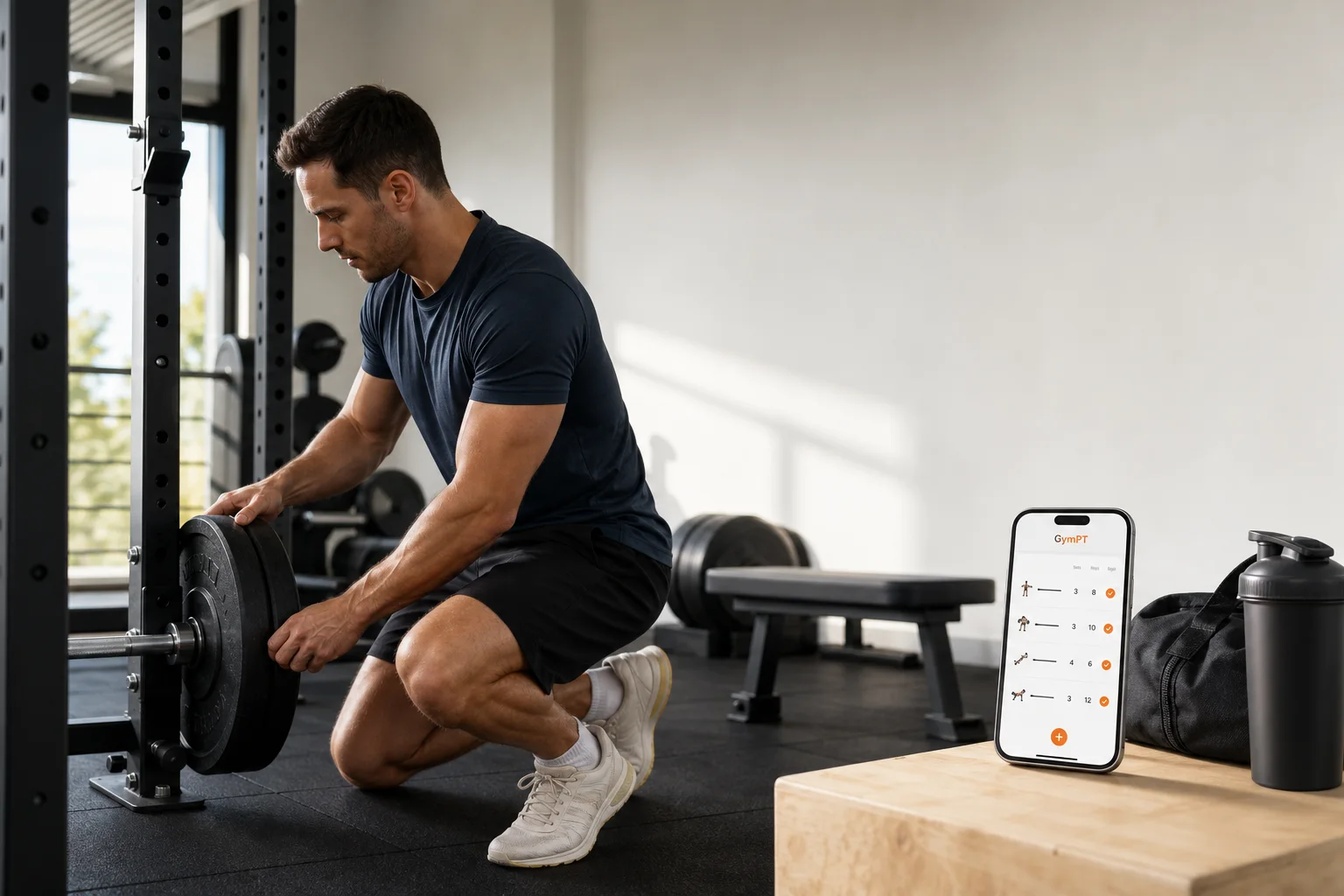
A 40 minute muscle building workout plan can make productive use of a busy gym session without turning every exercise into a rushed superset. The key is to choose a manageable number of movements, perform challenging sets with sound technique, and repeat the plan long enough to track progress.
This guide gives you two alternating full-body workouts. Each uses a few main lifts and a short accessory pairing, with time for warm-up sets and useful rest. Start with two sessions per week on nonconsecutive days; if that fits your recovery and schedule, a third session can rotate back to Workout A.
What makes a 40-minute muscle-building workout effective?
Muscle growth, or hypertrophy, depends on consistent resistance training and a challenging effort—not on cramming in the most exercises possible. Choose loads that let you complete the target reps with controlled form, finishing most working sets with about 1–3 good reps left in reserve. You usually do not need to take every set to the point where another rep is impossible.
Progressive overload means gradually making the training stimulus more demanding as you adapt. That can mean adding a rep, using a slightly heavier load, or improving control and range of motion while keeping the same load. It does not mean increasing weight every workout regardless of technique.
For this plan, record your working weight and reps. The schedule is a starting point, not a rule that every lifter must follow. If you are new to lifting, returning after a break, or unsure how to perform a movement, use a lighter load and prioritize learning the exercise.
Your 40 minute muscle building workout plan
Alternate Workout A and Workout B. Allow roughly five minutes for general movement and gradual warm-up sets, about 30 minutes for the listed exercises, and a few minutes for transitions. Warm-up sets are not counted as working sets.
Workout A: squat, press, and pull
- Squat or leg press: 3 sets of 6–10 reps. Rest about 2 minutes between working sets.
- Bench press or machine chest press: 3 sets of 8–12 reps. Rest about 90–120 seconds between sets.
- Seated cable row or chest-supported row: 3 sets of 8–12 reps. Rest about 90–120 seconds.
- Pair: hamstring curl and cable triceps press-down: 2 sets of 10–15 reps for each. Move between exercises, then rest about 60–90 seconds before repeating the pair.
Keep the squat or leg press and the two upper-body lifts as the session’s main priorities. If the gym is busy, select a stable alternative you can perform safely rather than waiting so long that the session becomes rushed.
Workout B: hinge, vertical press, and pull
- Romanian deadlift or hip thrust: 3 sets of 6–10 reps. Rest about 2 minutes. Choose the option you can perform confidently with consistent technique.
- Overhead press or machine shoulder press: 3 sets of 8–12 reps. Rest about 90–120 seconds.
- Lat pulldown or assisted pull-up: 3 sets of 8–12 reps. Rest about 90–120 seconds.
- Pair: split squat and dumbbell curl: 2 sets of 8–12 reps per side for split squats and 10–15 reps for curls. Alternate exercises, then rest about 60–90 seconds before repeating.
For single-leg work, the rep target applies to each side. Start with the less coordinated or weaker side, and match its reps on the other side. If time is running short, keep the main lifts and complete one accessory round; do not cut rest so much that your next set becomes sloppy.
How to fit the session into 40 minutes
Use a timer as a gentle guide, not a reason to rush heavy lifts. One workable outline is:
- Minutes 0–5: easy movement and specific warm-up sets for the first lift.
- Minutes 5–15: first main lift, including working sets and rest.
- Minutes 15–24: second main lift.
- Minutes 24–33: third main lift.
- Minutes 33–40: accessory pairing, transitions, and a brief workout note.
Exact timing depends on your equipment, experience, and how quickly you move between stations. If you need more recovery to maintain good technique, take it. You can shorten a session by doing one fewer accessory set rather than turning every rest interval into a sprint.
Pairing exercises that use different muscle groups can save time—for example, hamstring curls with triceps press-downs. Avoid pairing two demanding exercises if it makes either movement harder to perform well. Supersets are a time-management option, not a requirement for muscle growth.
How to progress without guessing
Use a simple rep-range progression. Suppose your bench press target is 3 sets of 8–12. Keep the same weight while you build reps with consistent form. When you can complete 12 reps on all three sets while still leaving roughly 1–3 reps in reserve, increase the load by the smallest practical amount at your next session. Your reps may drop toward the lower end of the range, which is expected.
- Log the exercise, load, reps for each set, and any note that affects performance.
- Compare like with like: the same exercise, setup, range of motion, and similar effort.
- Increase one variable at a time. Extra reps are progress; weight is not the only measure.
- If reps or technique repeatedly fall, keep the load steady or reduce it slightly instead of forcing an increase.
Training records make it easier to see whether a plan is working for you. In GymPT, members can save workout records and connections with a free account. You can build a manual plan without AI credits, request optional AI support, or review and save a program proposal from a personal trainer. A trainer reviews only the programs, workout records, and notes you permit them to share.
For more detail on tracking gradual changes, read Progressive Overload Workout Plan: Track Progress Without Guesswork. If you want a broader time-efficient session structure, see the 40 Minute Full Body Workout Plan.
Weekly schedule and recovery
Begin with two nonconsecutive sessions, such as Monday and Thursday. Do Workout A in the first session and Workout B in the second. This gives you practice across the week while leaving days between workouts. If you prefer three gym days, rotate A, B, A one week and B, A, B the next. That keeps the routine balanced over time without repeating the exact same workout every session.
Muscle-building training also needs recovery between sessions. Keep sleep regular where possible, eat enough to support your goals, and include protein-containing foods across the day. A sports nutrition position stand describes 1.4–2.0 grams of protein per kilogram of body weight per day as sufficient for most exercising people; individual needs and circumstances vary. Adults are generally advised to get at least seven hours of sleep regularly, though personal sleep needs differ.
If you are consistently sore, unusually tired, or losing performance across several sessions, consider reducing accessory work, keeping more reps in reserve, or adding another rest day. Persistent or concerning symptoms are a reason to seek qualified professional guidance, not to push through a workout plan.
Want to match the weekly structure to your experience? Compare it with this Beginner Workout Split: Choose a Simple Weekly Plan. For a two-day alternative centered on machines, see the 2 Day Machine Only Workout Plan.
Make the plan yours
Use the listed exercises as starting choices, not mandatory equipment. A chest press can replace a bench press; a leg press can replace a squat; and a pulldown can replace an assisted pull-up. Keep the movement pattern and effort appropriate to your experience, and avoid changing exercises every week unless access, comfort, or progress gives you a reason.
Give the routine several weeks of consistent practice before making major changes. Review your log, look for gradual improvements in reps or load, and adjust only what you can recover from. A focused 40-minute session is useful when it is repeatable—and when each set has a clear purpose.