
3 Day Upper Lower Workout Plan: A Balanced Two-Week Rotation
A three-day schedule can fit an upper/lower split—if you plan beyond a single week. Use this rotating template to balance sessions, recover and progress.
In this article
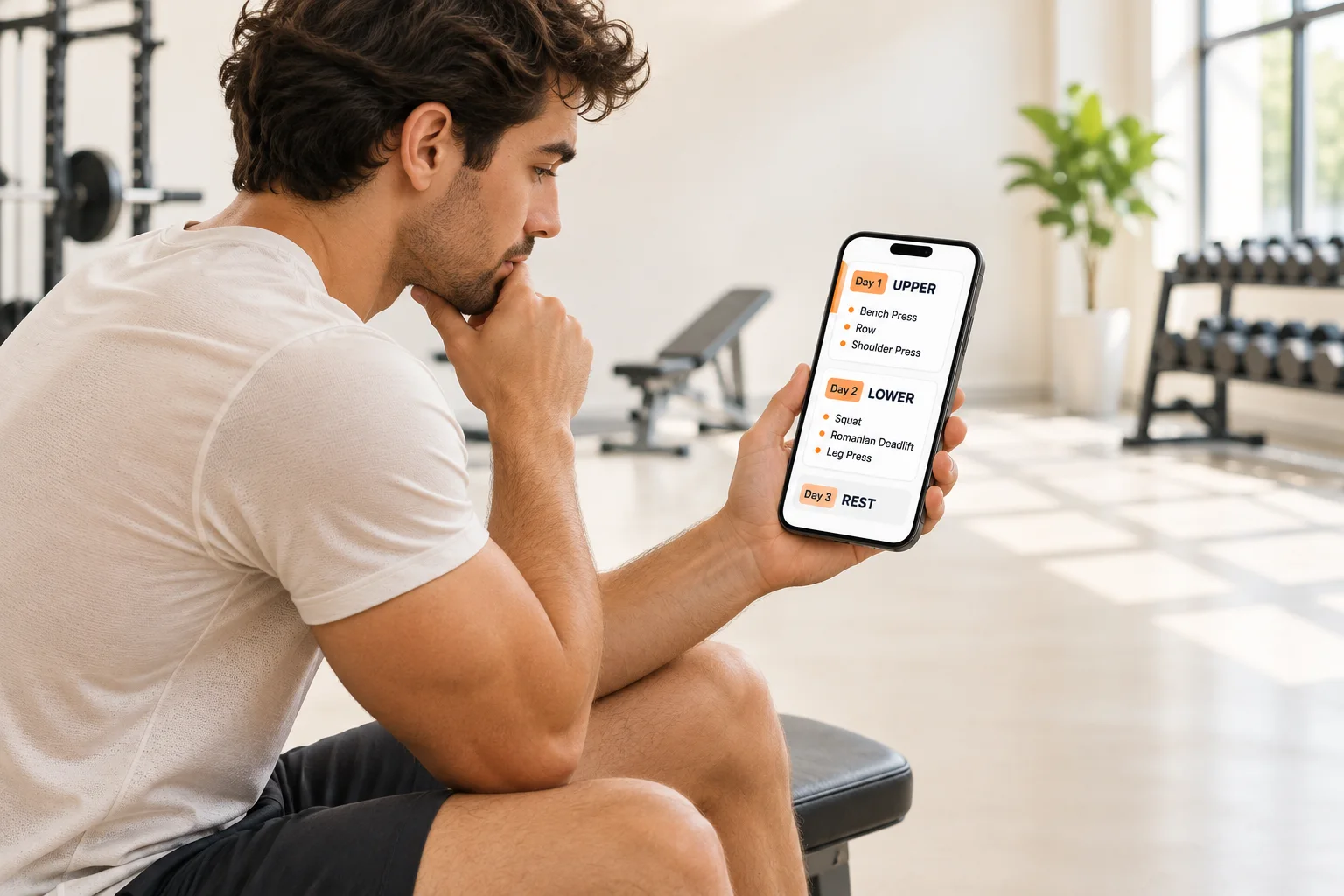
A 3 day upper lower workout plan can be a good fit if you want focused sessions but can train only three days a week. The scheduling catch is that three sessions do not divide evenly into upper and lower workouts: a simple upper–lower–upper week gives your upper body two sessions and your lower body one.
One practical fix is to rotate the emphasis over two weeks. You still train on three days each week, but alternate which body region gets the extra session. This guide gives you a sample rotation, exercise options, recovery ideas and a progression method you can repeat. Treat the templates as starting points, not a requirement to copy every exercise.
How a three-day upper/lower rotation works
Choose three training days with a rest day between sessions where possible—for example, Monday, Wednesday and Friday. In the first week, do two upper sessions and one lower session. In the second week, switch the balance. Across the two-week cycle, each region gets three focused sessions.
- Week A: Upper A, Lower A, Upper B.
- Week B: Lower B, Upper A, Lower A.
Then repeat from Week A. This approach gives you a clear schedule without pretending that every calendar week has an identical upper/lower split. Frequency is one way to distribute your training; research reviews suggest that when weekly training volume is similar, changing frequency alone does not necessarily produce meaningfully different muscle-growth results. Pick a schedule that helps you complete your work consistently and recover between sessions.
If you would rather train each region equally in every calendar week, a different split may suit you better. Compare this rotation with a four-day upper/lower schedule or a two-day upper/lower plan.
Sample 3 day upper lower workout plan
Use the following as an example for a healthy adult who already knows the basic movements. Choose a comfortable variation you can perform with controlled technique. The listed sets are working sets; do a few lighter warm-up sets before demanding exercises if needed. Rest long enough to be ready for the next set—often around two to three minutes for challenging compound lifts, and somewhat less for smaller accessory exercises.
Week A: two upper sessions, one lower session
Day 1 — Upper A
- Bench press or machine chest press: 3 sets of 6–10 reps
- Seated cable row or chest-supported row: 3 sets of 8–12 reps
- Overhead press or dumbbell shoulder press: 2 sets of 8–12 reps
- Lat pulldown: 2 sets of 8–12 reps
- Triceps pressdown: 2 sets of 10–15 reps
- Dumbbell curl: 2 sets of 10–15 reps
Day 2 — Lower A
- Squat or leg press: 3 sets of 6–10 reps
- Romanian deadlift: 3 sets of 8–10 reps
- Split squat or step-up: 2 sets of 8–12 reps per side
- Leg curl: 2 sets of 10–15 reps
- Calf raise: 2 sets of 10–15 reps
Day 3 — Upper B
- Incline dumbbell press: 3 sets of 8–12 reps
- One-arm dumbbell row or cable row: 3 sets of 8–12 reps per side
- Lat pulldown or assisted pull-up: 2 sets of 8–12 reps
- Lateral raise: 2 sets of 12–15 reps
- Rear-delt fly: 2 sets of 12–15 reps
- Optional biceps or triceps exercise: 2 sets of 10–15 reps
Week B: two lower sessions, one upper session
Day 1 — Lower B
- Deadlift variation or hip thrust: 3 sets of 5–8 reps
- Front squat, goblet squat or leg press: 3 sets of 8–12 reps
- Reverse lunge: 2 sets of 8–12 reps per side
- Leg curl: 2 sets of 10–15 reps
- Calf raise: 2 sets of 10–15 reps
Day 2 — Upper A
Repeat Upper A, or use a similar variation if you need a change that suits your equipment. Keeping the main movements stable makes it easier to compare sessions over time.
Day 3 — Lower A
Repeat Lower A. If the first lower session left you unusually fatigued, reduce a set or choose a less demanding variation rather than forcing the same workload.
Adjust the plan to your experience
New to consistent lifting? Start with two working sets per exercise and use the lower end of each rep range. You can also remove one accessory movement from each workout. The goal is to learn the exercises, complete sessions with repeatable technique and build a routine you can sustain—not to make the first week exhausting.
Have some training experience? Begin with the listed sets if they feel manageable and your schedule allows adequate recovery. If you already train regularly, keep your current useful exercises where possible and adjust the number of sets gradually. Avoid adding several exercises and extra sets at once; that makes it harder to tell what is helping or making recovery difficult.
The sample plan includes pressing and pulling for the upper body, plus squat, hinge and single-leg patterns for the lower body. Those are categories, not mandatory movements. If a particular exercise is uncomfortable, unfamiliar or unavailable, choose a suitable alternative and learn it at a manageable load. A personal trainer can help you adapt choices to your experience and available equipment.
Recovery: make the schedule fit your week
Nonconsecutive training days are a convenient starting point because they leave space between demanding sessions. They are not a magic rule: work, sleep, other activity and how hard you train all affect how the schedule feels. If you must train on consecutive days, avoid placing your hardest work for the same area back-to-back and consider trimming the session that follows.
- Keep at least one rest or lighter day between sessions when your calendar permits.
- Leave a set unfinished if your technique is breaking down; every set does not need to reach failure.
- If performance is repeatedly falling or you are not ready for the next session, reduce a little volume or load and reassess.
- Use rest days for ordinary movement or complete rest according to your preference; they do not need to become extra hard workouts.
For more schedule options, see the five-day upper/lower plan. Its higher training frequency is not automatically better; it may simply help some people spread their sessions differently.
Progress without changing the plan every week
Use a simple double-progression method. Pick a load that lets you complete the lower end of the target rep range with controlled technique. Over later sessions, try to add repetitions while keeping the load the same. When you can reach the top of the range for every set with consistent form, increase the load by a small amount next time and build the reps again.
- Record the exercise, load and completed reps for each working set.
- Repeat the same movement long enough to make a fair comparison.
- Add reps first when the current load is manageable and technique stays steady.
- Increase load modestly after you reach the top of the rep range across sets.
- Adjust only when needed: if you cannot maintain the intended reps or form, keep the load, reduce it slightly or choose a more suitable variation.
Track both weeks of the rotation. Because the emphasis changes between Week A and Week B, compare Upper A with the next Upper A rather than treating every workout as the same session. A training log makes this comparison easier and helps you see whether your plan is realistic.
Make the plan your own
Start with a schedule you can repeat for several weeks. Keep the main movement patterns, adapt exercises to your equipment and experience, and add work only when your current sessions are going well. If you work with a personal trainer, you can review a program proposal and decide whether to save and follow it; the right plan is one you understand and are willing to use.
GymPT lets members build a program manually, keep workout records with a free account, request optional AI assistance, or review and save a trainer’s proposal. Optional AI actions may require credits, and eligible Premium features show their requirements before use. You control which programs, workout records and notes you share with a connected trainer. For help comparing approaches, read the three-day push/pull/legs guide or what to look for in a personalized gym app.
In short: an upper/lower split can work on three training days when you plan across a two-week rotation. Choose manageable exercise variations, leave room to recover, record your work and progress gradually.