automatic workout plan app
Automatic Workout Plan App: How to Choose One That Actually Fits You
An automatic workout plan app should do more than generate random exercises. Learn how to evaluate personalization, progression, equipment matching, tracking, and AI coaching before choosing one.
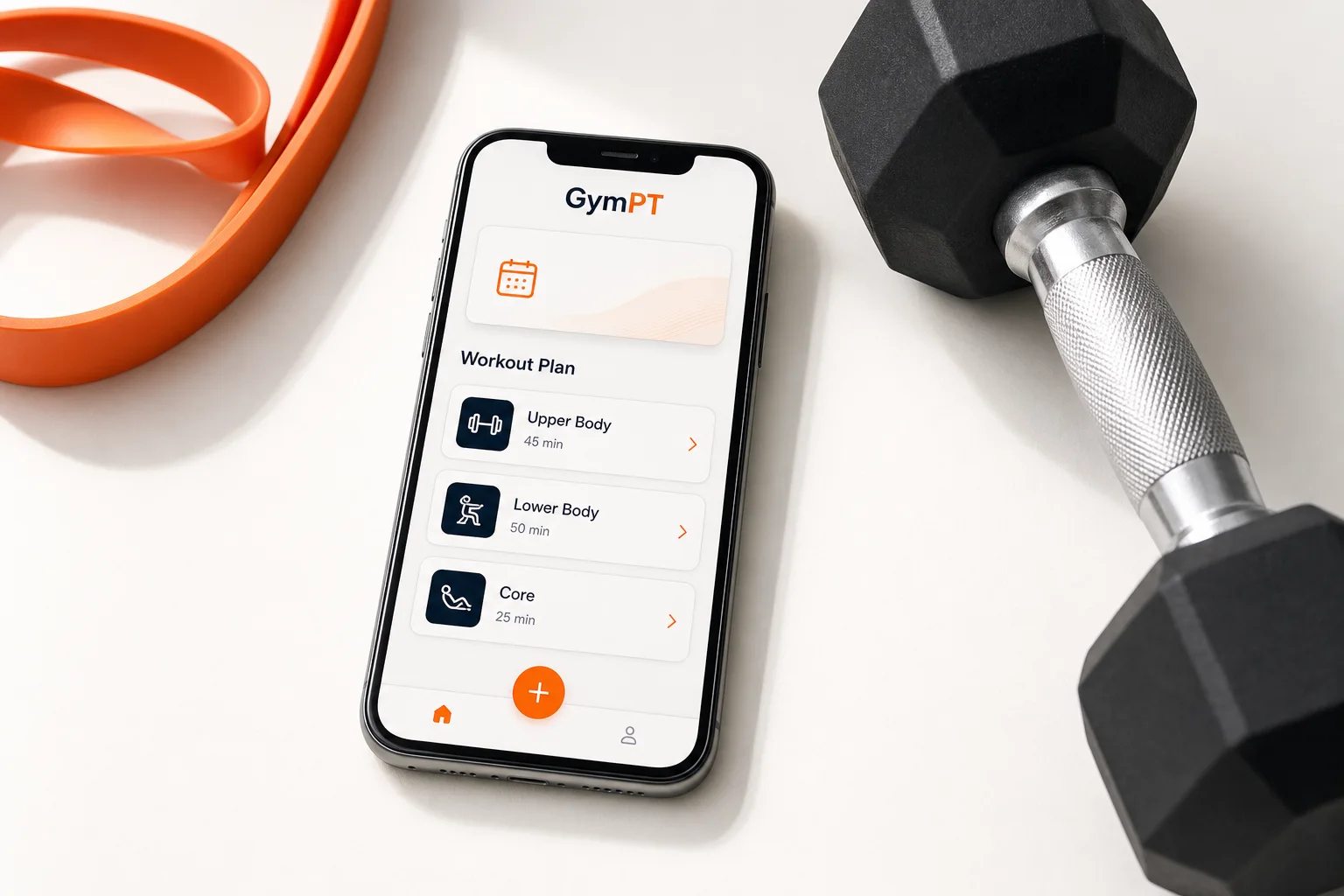
Choosing an automatic workout plan app can save time, reduce decision fatigue, and make training easier to follow. But not every app that generates a routine creates a useful plan. Some simply assemble exercises from a library, while better tools consider your goals, schedule, experience, equipment, and performance over time.
The difference matters. A good plan should feel realistic enough to complete, structured enough to create progress, and flexible enough to adapt when your circumstances change. This guide explains what to look for and how GymPT approaches the process as an AI personal trainer.
What should an automatic workout plan app actually do?
At its simplest, an automatic workout planner gives you exercises to perform. A more capable app turns that list into a training system. It helps answer practical questions such as:
- How many days should you train each week?
- Which exercises suit your current level?
- What can you do with the equipment available today?
- How should sets, repetitions, and rest periods be organized?
- What should change when you improve, miss a session, or have less time?
For adults, general public-health guidance recommends combining aerobic activity with muscle-strengthening work on at least two days per week. That does not mean everyone needs the same schedule or training split. Your plan still needs to reflect your goal, availability, recovery, and preferences.
That is why the best automatic workout plan app is not necessarily the one with the largest exercise library. It is the one that makes appropriate decisions for your situation and explains enough of the reasoning for you to train confidently.
7 features to compare before choosing an automatic workout plan app
1. Goal-based planning
Start with the outcome you care about. Strength, muscle gain, general fitness, fat loss, mobility, and improved consistency can all require different priorities.
A useful app should ask about your goal before creating your plan. It should also avoid treating the goal as a permanent label. Your priorities may change after several weeks, and your plan should be easy to adjust without rebuilding everything manually.
For example, a strength-focused plan may prioritize heavier resistance and clear progression. A muscle-building plan may use more weekly volume and distribute work across several sessions. A general fitness plan may emphasize full-body training and a schedule that is easier to maintain.
If you want a deeper look at how goals affect weekly structure, read AI Workout Plan by Goal: Choose the Right Training Week for Your Results.
2. Personalization by experience level
A beginner does not need the same exercise selection, volume, or instruction as an experienced lifter. A plan that is too advanced can be intimidating and difficult to perform safely. A plan that is too easy may not provide enough challenge for someone with years of training experience.
Look for an app that accounts for your training history and current ability. Personalization can include exercise complexity, number of working sets, repetition ranges, rest periods, and progression speed.
Good personalization also avoids unnecessary complexity. Recent resistance-training guidance emphasizes consistency and appropriate effort over complicated methods. You should not need an advanced periodization system or extreme training techniques to make steady progress.
3. Equipment-based exercise selection
Your plan should match the equipment you can actually use. A home workout with adjustable dumbbells is different from a commercial gym session with machines, cables, barbells, and benches.
This is one of the most important differences between a practical personalized workout app and a generic routine generator. If an app recommends exercises you cannot perform, you must spend time replacing them yourself. That creates friction before the workout even starts.
A stronger system lets you specify the equipment available and then builds sessions around it. It should also provide sensible alternatives when a machine is occupied, your home setup changes, or a particular exercise does not suit you.
GymPT supports equipment-based training so your plan can be built around what you have available. You can also explore related guidance in Machine-Based Workout Plan: Build a Gym Routine Around Your Equipment and AI Workout Planner With Dumbbells: Build a Smarter Home Strength Plan.
4. A realistic weekly schedule
Theoretically ideal plans are not useful if they do not fit your calendar. Before choosing an app, check whether it lets you set training frequency, session length, preferred training days, and location.
A realistic plan might include two full-body sessions per week for someone with a busy schedule. Another person may prefer four shorter sessions organized around upper- and lower-body training. Neither approach is automatically better. The right choice is the one you can repeat consistently while recovering well.
Your app should also handle interruptions. If you miss Wednesday’s workout, it should help you continue rather than making you feel that the entire week has failed. Flexibility is part of personalization.
5. Progression that is easy to understand
Completing workouts is only part of the process. A training plan should give you a reasonable way to progress through increases in repetitions, resistance, sets, exercise difficulty, or training quality.
Progression does not mean adding weight every session regardless of how you feel. It means gradually increasing the challenge when your current workload becomes manageable. The app should help you recognize that pattern rather than encouraging random changes.
Useful progression features may include:
- Suggested repetition ranges
- Recorded weights and completed repetitions
- Previous-workout comparisons
- Exercise substitutions that preserve the training goal
- Notes about effort, comfort, and performance
For more detail on applying progression, see Strength Training Program: How to Progress Safely and Track Real Strength Gains.
6. Workout tracking and progress insights
Memory is not a reliable tracking system. After several weeks, it becomes difficult to remember which weights, repetitions, and exercises you used. A workout tracking app should make recording simple enough that you will actually do it.
Look beyond basic checkmarks. The most useful progress insights help you identify trends, such as improving performance on a key exercise, completing more sessions, or consistently training a muscle group. They can also reveal when your plan is too demanding or when you are repeating the same workload without progressing.
GymPT combines workout logging with progress insights so your future recommendations can be informed by what you have already done. This creates a feedback loop: the app plans a session, you record the result, and the next plan can become more relevant.
7. Coaching and explanations
Automation is helpful, but it should not feel like a black box. If you do not understand an exercise, cannot use the recommended equipment, or wonder why your routine changed, you need a way to ask questions.
An AI coach chat can make an automatic plan more usable by helping with exercise explanations, substitutions, scheduling questions, and general training decisions. It should support your plan rather than replace judgment or professional medical advice.
Helpful coaching is specific. Instead of simply saying “train harder,” it might explain how to adjust a movement, when to rest longer, or how to choose between two equipment options. That type of context can make the difference between abandoning a routine and completing it.
How GymPT creates a more personal workout plan
GymPT is designed to combine automatic planning with ongoing adjustment. You can use it to define your training goal, account for available equipment, and receive workouts that fit your preferred structure.
The experience includes several connected tools:
- Personalized workout plans: Training sessions are organized around your goals, level, schedule, and available equipment.
- AI coach chat: Ask practical questions about exercises, substitutions, training structure, and next steps.
- Body analysis: Use body-related information as one input for more informed fitness planning, without treating a single measurement as the full picture.
- Workout tracking: Record exercises, sets, repetitions, and performance during your sessions.
- Progress insights: Review patterns over time instead of relying on isolated workout results.
The goal is not to create the most complicated routine possible. It is to reduce the planning work while keeping your training understandable, adaptable, and consistent.
How to tell whether an automatic workout plan app is working for you
After using an app for a few weeks, review the quality of the experience—not just the number of workouts generated. Ask yourself:
- Can I complete the sessions within the time I have?
- Do the exercises match my equipment and current ability?
- Do I understand what I am supposed to improve?
- Can I easily record what I did?
- Does the plan adapt when my schedule or preferences change?
- Am I becoming more consistent?
If the answer is “no” to several questions, the problem may not be your motivation. The app may simply be giving you too much friction or too little personalization.
What an automatic plan cannot replace
An app can organize training, explain general fitness concepts, and help you track progress. It cannot observe every repetition, diagnose pain, or account for every health condition.
Use normal judgment during training. Stop an exercise if you experience concerning pain, choose appropriate loads, and seek qualified professional guidance when you have an injury, medical condition, or specific clinical concern. GymPT is a fitness guidance tool, not a medical device.
Final checklist for choosing your app
Before committing to an automatic workout plan app, make sure it offers:
- Goal-based programming
- Beginner-to-advanced personalization
- Equipment-aware exercise selection
- Flexible weekly scheduling
- Clear progression recommendations
- Simple workout logging
- Useful progress insights
- Accessible coaching or explanations
The best automatic workout planner is not the one that promises a perfect routine instantly. It is the one that helps you make good training decisions repeatedly. By combining personalized plans, equipment-based workouts, AI coaching, body analysis, and progress tracking, GymPT gives you a practical way to turn a general goal into a routine you can follow.